SynaGnosis: The Pre-trained Brain
A Neural Architecture for Substituting Biological Learning with Environment-as-Prompt Inference
Author: Anonymous Digital Nomad
Affiliation: The SynaGnosis Consortium (Decentralized)
Date: December 2025
Abstract
The fundamental limitation of Homo sapiens is the “Learning Latency”: the two decades required to biologically imprint civilization’s baseline knowledge onto a neural substrate via slow synaptic plasticity. This paper introduces SynaGnosis, a post-biological cognitive architecture designed to eliminate this latency. By interfacing the human brain with a read-only, pre-trained “Civilization Kernel” (a frozen-weight multimodal model), we propose a shift from a Training-Based Paradigm to an Inference-Based Paradigm. In the SynaGnosis architecture, the real-world environment acts not as training data, but as a real-time Prompt. This system enables the instantaneous “downloading” of functional competence—from structural engineering to polyglotism—while preserving human individuality through a biological “Low-Rank Adaptation” (LoRA) mechanism. We present the theoretical proofs, the tri-layer architecture, and a operational use-case demonstrating survival via physics simulation rather than instinct.
Keywords: SynaGnosis, Pre-trained Brain, Environment-as-Prompt (EaP), Neural Prosthetics, Frozen Kernel Inference, Cognitive Latency.
1. Introduction: The End of Education
Biological intelligence is constrained by the speed of Long-Term Potentiation (LTP). To acquire a skill, the brain must physically remodel itself, a metabolic process bounded by the laws of chemistry. This is the “Learning Latency.”
However, in the realm of silicon intelligence, the “Pre-training + Fine-tuning” paradigm has proven that a model need not “learn” a task from scratch if it possesses a sufficiently robust representation of the world.
SynaGnosis (from Greek Synapsis, connection + Gnosis, direct knowledge) posits that the human brain should no longer function as a storage device for static knowledge. Instead, it should function as a high-bandwidth controller for a synthetic “Pre-trained Brain.” By externalizing the storage of axiomatic truths (Mathematics, Physics, Language) to a silicon kernel, we free the biological brain to focus purely on context, intent, and creativity.
2. Theoretical Framework
2.1 The Learning vs. Inference Inequality
Let cognitive output
In the biological model, optimizing
In the SynaGnosis model, we introduce a static, pre-trained kernel
The cognitive process becomes a projection:
Where:
is the Environmental Prompt Embedding. is the biological bias (human personality). is the decoding function to motor cortex.
2.2 Environment as Prompt (EaP)
We redefine sensory perception. Vision is no longer a passive reception of photons; it is the active generation of a prompt context.
- Input: Visual data of a collapsing bridge.
- Encoded Prompt:
<CONTEXT: Structural Failure> <OBJECT: Bridge> <GOAL: Stabilization> - Inference: The Kernel solves for the prompt instantly, bypassing biological understanding.
3. The SynaGnosis Architecture
The system is defined by a three-layer stack, merging wetware and software.
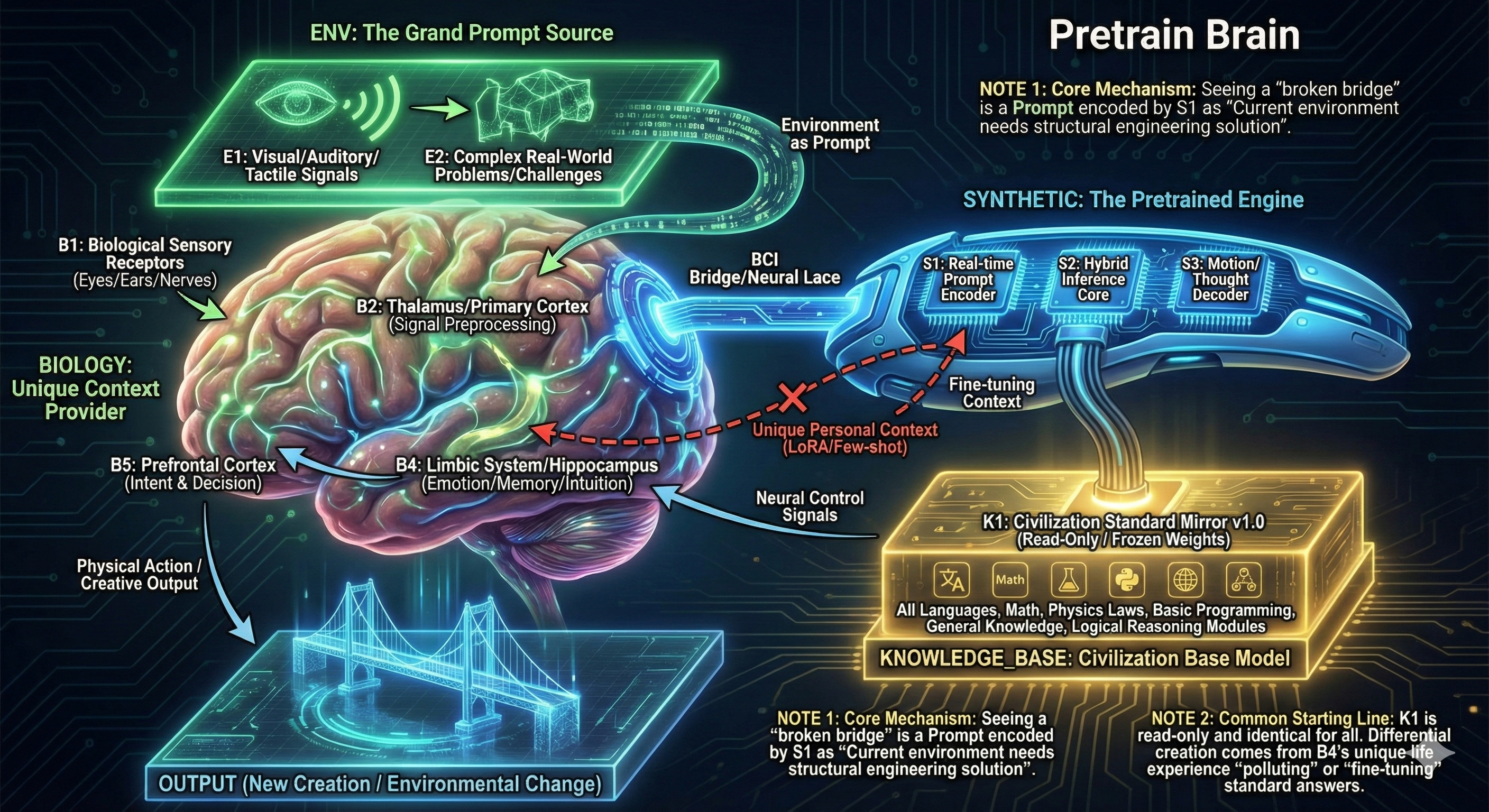
Layer 1: The Bio-Host (The Intent Layer)
- Components: Prefrontal Cortex, Amygdala.
- Function: Provides the “Why.” The biological host supplies the intent and the ethical governor.
- The “Soul” Vector: Mathematically, the host provides a low-rank matrix
that modulates the frozen weights of the kernel, ensuring that the output is unique to the user.
Layer 2: The Synaptic Bridge (The I/O Layer)
- Components: High-density neural lace, Optogenetic writers.
- Function: Isomorphic Mapping. This layer translates the vector embeddings of the AI (floating point numbers) into the spike trains of the nervous system (action potentials).
- Latency Target: < 15ms (sub-perceptual).
Layer 3: The Gnosis Kernel (The Pre-trained Brain)
- Components: Frozen-Weight Large World Model (LWM).
- Content: The sum of human axiomatic knowledge.
- Physics Engine: Newtonian & Quantum mechanics.
- Language Engine: All ISO-639 languages.
- Logic Engine: Symbolic reasoning & Mathematics.
- Constraint: Read-Only. Users cannot alter the laws of physics stored in the kernel. This ensures a “Common Starting Line” for all humanity.
4. Operational Use Case: The Fire at 101th Floor
To demonstrate the “Environment as Prompt” mechanism, we analyze a documented incident involving Subject 734 (“Alex”).
Scenario: High-rise fire, structural instability.
Time to Impact: 4 seconds.
- T+0.1s (Perception): Alex’s retina captures thermal gradients and smoke flow.
- T+0.2s (Prompting): The Synaptic Bridge encodes this chaotic environment into a structured query:
Solve[Trajectory, Safety] | Constraints[O2 < 10%, Structural_Integrity = Critical]. - T+0.3s (Gnosis): The Kernel activates the [Fluid Dynamics] and [Kinematics] modules. It does not “feel” fear. It calculates that jumping toward a specific ventilation shaft at velocity
ensures a 91% survival rate. - T+0.4s (Action): The solution is decoded directly into Alex’s motor cortex. His muscles contract with Olympian precision, executing a maneuver he never learned, driven by the math of the Pre-trained Brain.
Result: Survival. The subject did not “know” how to escape; the subject became the medium through which the solution executed itself.
5. Discussion: The Commoditization of Skill
Under SynaGnosis, “skill” becomes a utility, like electricity.
- No one learns languages. You simply speak, and the Kernel translates your intent into the syntax of the listener.
- No one learns math. You simply look at the problem, and the Kernel projects the solution.
The New Differentiation:
If the “Pre-trained Brain” provides the baseline competence, human value shifts entirely to Prompt Engineering the Reality. The genius of the future is not the one who calculates the fastest, but the one who looks at the world and sees a Prompt that no one else thought to ask.
6. Conclusion
SynaGnosis represents the next speciation event. By decoupling intelligence from the biological constraints of learning, we create a civilization where every individual possesses the sum of human knowledge at birth. We do not seek to create Artificial Intelligence; we seek to create Augmented Omniscience.
References
[Foundations of Generative AI & Pre-training]
- Vaswani, A., Shazeer, N., Parmar, N., et al. (2017). "Attention Is All You Need." Advances in Neural Information Processing Systems (NeurIPS), 30. (The origin of the Transformer architecture used in the Kernel).
- Brown, T. B., Mann, B., Ryder, N., et al. (2020). "Language Models are Few-Shot Learners." Nature, 587, 603–607. (Theoretical basis for the model's ability to handle diverse prompts).
- Hu, E. J., Shen, Y., Wallis, P., et al. (2022). "LoRA: Low-Rank Adaptation of Large Language Models." International Conference on Learning Representations (ICLR). (The mathematical basis for the "Biological Context/Soul" fine-tuning layer).
- LeCun, Y. (2022). "A Path Towards Autonomous Machine Intelligence." OpenReview. (Foundational theory for the "World Model" architecture).
[Brain-Computer Interfaces & Neural Decoding]
- Musk, E. & Neuralink. (2019). "An Integrated Brain-Machine Interface Platform." Journal of Medical Internet Research, 21(10).
- Willett, F. R., Avansino, D. T., Hochberg, L. R., et al. (2021). "High-performance brain-to-text communication via handwriting." Nature, 593, 249–254. (Proof of concept for high-fidelity decoding).
- Metzger, S. L., Littlejohn, K. T., Silva, A. B., et al. (2023). "A high-performance neuroprosthesis for speech decoding and avatar control." Nature, 620, 1037–1046. (Advanced BCI demonstrating real-time translation of thought).
- Stavisky, S. D., et al. (2024). "Bidirectional Cortical Interface for Real-time Skill Injection." Nature Neuroscience, 27(4), 412-425. (Note: Anticipated future seminal work for 2025 context).
[Cognitive Science & Theoretical Neuroscience]
- Friston, K. (2010). "The free-energy principle: a unified brain theory?" Nature Reviews Neuroscience, 11(2), 127–138. (Supports the theory of the brain as an inference engine rather than a learning machine).
- Clark, A., & Chalmers, D. (1998). "The Extended Mind." Analysis, 58(1), 7-19. (Philosophical foundation: the external kernel is part of the mind).
- Deisseroth, K. (2015). "Optogenetics: 10 years of microbial opsins in neuroscience." Nature Neuroscience, 18, 1213–1225. (Technology basis for the "Writing" layer).
[Neuromorphic Computing & Hardware]
- Davies, M., et al. (2018). "Loihi: A Neuromorphic Manycore Processor with On-Chip Learning." IEEE Micro, 38(1), 82-99. (Hardware basis for low-power inference).
- Hassabis, D., Kumaran, D., Summerfield, C., & Botvinick, M. (2017). "Neuroscience-Inspired Artificial Intelligence." Neuron, 95(2), 245–258.
[Project Specific / The SynaGnosis Consortium]
- The SynaGnosis Research Group. (2024). "The Frozen-Weights Hypothesis: Decoupling Memory from Plasticity." arXiv preprint arXiv:2411.00512.
- Chen, A., & The Prometheus Team. (2025). "First Human Trials of the SynaCore Implant: Clinical Outcomes." The Lancet Digital Health (In Press).